Squatters in Spain: what owners must do in the first 48 hours

In short: call the police (112) as soon as you find out, never try to get the occupants out yourself, gather proof that the property is yours and that you use it, and contact a lawyer or your insurer’s legal helpline the same day. Since 3 April 2025, occupation cases can go through Spain’s fast-track criminal procedure when the legal conditions are met.
Few things worry property owners in Spain more than okupas, people who move into a home without permission. The good news is that the law has become faster, and most occupations can be prevented or solved if you act correctly from the very first moment. This guide explains, in plain English, what to do and what not to do.
First: is it your home or an empty property?
Spanish law treats two situations very differently, and which one applies to you shapes everything that follows.
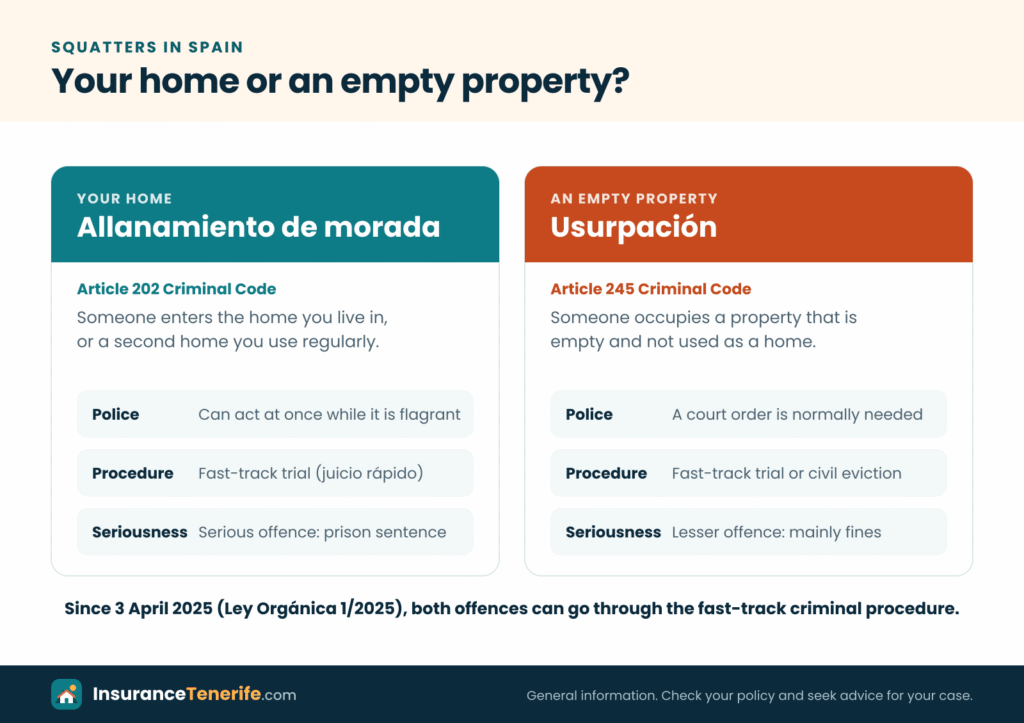
- Allanamiento de morada (breaking into a dwelling): someone enters the home you live in, including a second home you use regularly, such as a holiday apartment you visit every winter. It is a serious offence, and the police can act immediately while it is still a flagrant crime.
- Usurpación (unlawful occupation): someone occupies a property that is empty and not used as a home, such as a flat waiting to be sold or a newly built unit. Recovering it normally requires a court order.
What changed in 2025
Ley Orgánica 1/2025 came into force on 3 April 2025. It added both offences, allanamiento de morada (article 202 of the Criminal Code) and usurpación (article 245), to the list of crimes that can be tried through the juicio rápido, Spain’s fast-track criminal procedure, when the conditions in article 795 of the Criminal Procedure Act are met. In practice this can cut the time it takes to get a ruling considerably compared with the old procedure.
Owners also keep the civil “express eviction” created by Law 5/2018, available to individuals, non-profit entities and public bodies who own a home occupied without their consent. Which route is better depends on the property, the evidence and how quickly the occupation was discovered, so ask a lawyer before choosing.
A common myth says the police can only act in the first 48 hours. The law does not set that limit. What matters is that the occupation is still recent and flagrant, which is why reporting it immediately makes such a difference.
Your checklist for the first 48 hours
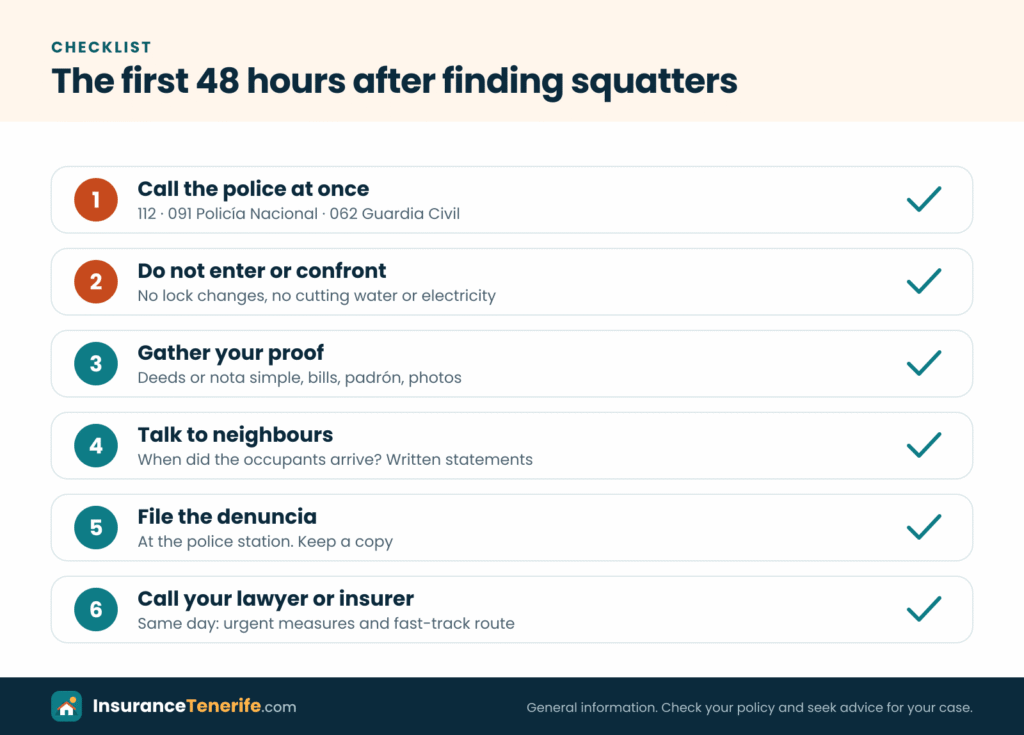
- Call the police straight away. Dial 112 (emergencies), 091 (Policía Nacional) or 062 (Guardia Civil). Give the address and say whether it is your home or second home.
- Do not enter or confront the occupants. Do not change the locks, remove belongings or cut off water or electricity. Doing so can expose you to a criminal complaint.
- Gather evidence. Title deeds or a nota simple from the Land Registry, utility bills in your name, your empadronamiento if you live there, photos and anything that shows you use the property.
- Ask neighbours and the community administrator. When did they see the occupants arrive? Written statements or messages with dates are very useful.
- File the complaint (denuncia) at the police station, and keep a copy.
- Call your insurer’s legal helpline or a lawyer the same day so they can ask the court for urgent measures.

If you live outside Spain
Many owners of second homes in Tenerife live in the UK, Ireland, Germany or Scandinavia. If you discover an occupation while you are abroad, ask a trusted neighbour, your community administrator or your lawyer to call the police in Spain straight away and to file the complaint with your documents. Your lawyer can act on your behalf with a power of attorney, so you do not need to travel for the first steps. Keep digital copies of your deeds and bills in the cloud so they can be sent within minutes.
How anti-squatter insurance helps
A standard home policy usually does not pay for the legal process to evict occupants. Anti-squatter insurance fills that gap. Depending on the insurer and the option chosen, it typically includes:
- a 24/7 legal helpline from the moment you discover the occupation;
- specialist lawyers and the procurador (court representative), paid by the insurer within the policy limits;
- a locksmith and sometimes an anti-squatter door once the property is recovered;
- optional cover for damage and cleaning.
Remember that, like any insurance, it only covers occupations that start after the policy is in force and once any waiting period has passed. It is a product to take out before you need it.
Prevention is the best protection
Most occupations happen in homes that look empty for weeks. A few simple measures make a big difference:
- Ask a neighbour or a key holder to collect the post and check the property regularly.
- Install a security door and good locks on balconies and ground-floor windows.
- Consider a monitored alarm with video verification. As an authorised Verisure partner we can offer you a special deal, and having an alarm can also lower the price of your home insurance.
- Use timers for lights and keep the garden and terrace looking cared for.
If you let the property, combine anti-squatter cover with rent guarantee insurance to protect yourself against tenants who stop paying and refuse to leave.
This article is general information and does not replace legal advice for your specific case.
Need advice for your own case?
Our team will explain your options in English and compare several insurers for you, free of charge.
Get a free quote